

Why Newsweek Got Its “Jihad Online” Cover Story Wrong
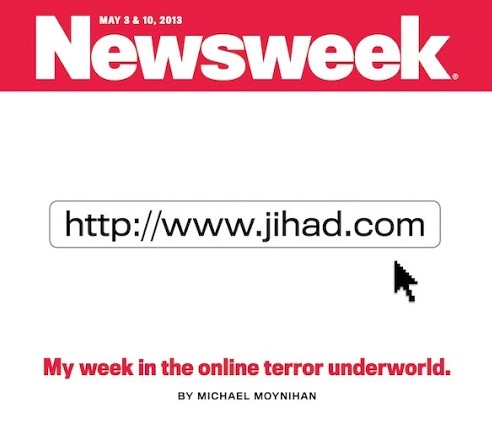
Newsweek recently published an article entitled www.Jihad.com by Michael Moynihan who conducted a 1-week experiment on himself to see how the jihadist web might psychologically influence him.
The idea came to Moynihan in the aftermath of the Boston marathon bombing, when eventually “pundits and experts across the political spectrum could be heard holding forth about the problem of “self-radicalization”—the process by which those unconnected to organized jihad are lured toward extremism via the Web.”
Moynihan writes:
I decided to try an experiment: I would spend seven days creeping through the Internet using disposable IP addresses, inhabiting the milieu of radical sites and Facebook pages. In Manhattan coffee shops, on subway platforms, between tasks at work, I would take up residence in the darkest corners of the Web—and see what I could learn about the fetid swamps where self-made jihadists are allegedly born.
It’s a clever idea, except it’s not.
The result of the experiment? Simply put, after days of regularly watching videos and images of gruesome pornographic butchery, Moynihan became desensitized to the violence.
Read the details here.
Other than that, the jihadist web didn’t turn him into a violent terrorist. And why would it?
Moynihan doesn’t share the same type of severe sociopolitical grievances and psychological predisposition that made Umar Farouk Abdulmutallab, blonde Jihad Jane, or the older Tsarnaev susceptible to radicalization.
Moreover, one can have a predisposition that compels one to react with horror and disgust at the plethora of online material promoting violence and dehumanizing hatred of any kind for that matter.
Hence, what we ought to focus on more is studying the causes that drive individuals online into those fringe communities and that make them susceptible to radicalization within them. Gotta tackle the root issues involved.
This is part of what I argued for in my recent Bloomberg piece, entitled How the Web Radicalizes and Liberates Muslims.
Yup, “and Liberates Muslims.” In fact, for a more thorough and much more in-depth understanding of these issues, I recommend reading my book, My Isl@m: How Fundamentalism Stole My Mind–and Doubt Freed My Soul.
May we more effectively utilize the web as a force for good.